Urology
Enlarged Prostate: Treatment Options for Men in Ghana
An enlarged prostate, medically known as Benign Prostatic Hyperplasia (BPH), is a common condition affecting men as they get older. It can cause difficulty urinating, frequent nighttime visits to the toilet, weak urine flow and incomplete bladder emptying.
While medication can help manage symptoms, some men may require a procedure or surgery, particularly when symptoms become severe or medication no longer provides sufficient relief.
Today, prostate treatment is no longer limited to conventional surgery.
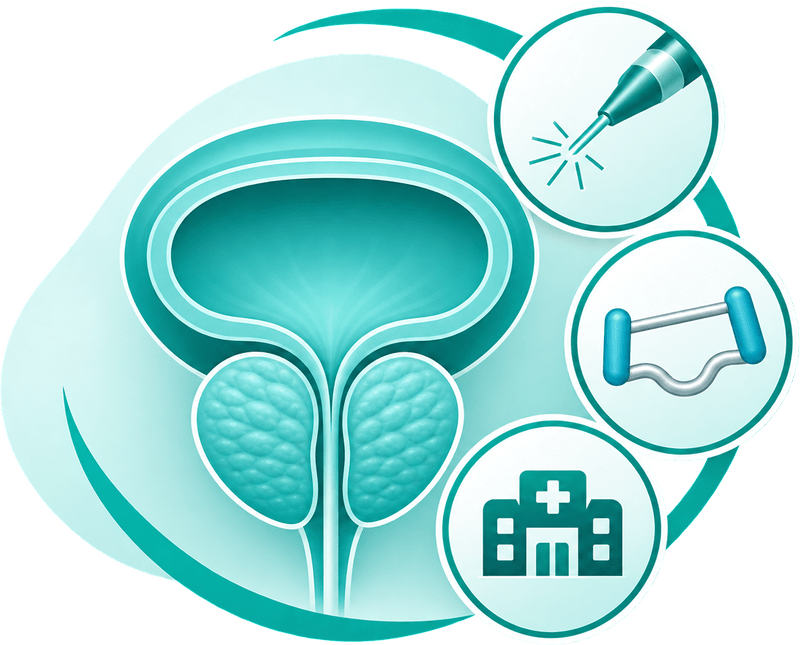
Advances in urology have introduced several minimally invasive options, including laser procedures, water vapour therapy and prostate implants.
For men in Ghana exploring treatment, understanding these options can help them make informed decisions about their healthcare.
know
A study of men aged 50 to 74 in Accra found that more than 6 in 10 had an enlarged prostate on examination. Early diagnosis and timely treatment can help prevent complications.Source: Prevalence of BPH and lower urinary tract symptoms in West Africans, Prostate Cancer and Prostatic Diseases (2012).
What Are the Treatment Options for an Enlarged Prostate?
Treatment depends on prostate size, symptom severity, bladder function, overall health and the patient’s preferences. Broadly, the available options include medication, minimally invasive procedures and surgery.
1. Medication for Prostate Enlargement
For men with mild to moderate symptoms, medication is often the first treatment approach.
Common medications include:
- Alpha blockers: Medicines such as Tamsulosin relax the muscles around the prostate and bladder neck, helping improve urine flow.
- 5-alpha reductase inhibitors: Medicines such as Finasteride and Dutasteride can gradually reduce prostate size and help prevent disease progression in suitable patients.
- Combination therapy: In some cases, doctors prescribe both types of medication to improve symptom control.
Although medication can provide relief, it may not be sufficient for men with significant urinary obstruction or complications such as recurrent urinary retention.
2. Minimally Invasive Treatments for Enlarged Prostate
Advances in urology have introduced procedures that aim to relieve urinary obstruction with less tissue removal, smaller interventions or shorter recovery periods compared with some conventional operations.
Some of the available options include:
a. Rezūm Water Vapour Therapy
Rezūm is a minimally invasive procedure that uses controlled water vapour (steam) to treat excess prostate tissue.
The steam releases thermal energy into the enlarged tissue, causing the treated cells to shrink over time. This helps create more space for urine to flow through the urethra.
- No external surgical incision is required.
- The procedure is generally performed through the urethra.
- It may be suitable for selected men with moderate to severe urinary symptoms.
- Improvement develops gradually as the treated tissue shrinks.
b. UroLift (Prostatic Urethral Lift)
UroLift is a minimally invasive procedure that uses small implants to hold enlarged prostate tissue away from the urethra.
By creating a wider passage for urine, it helps improve urinary flow without cutting or removing prostate tissue.
- No conventional tissue-removal surgery is required.
- It may be suitable for selected men with smaller or moderately enlarged prostates.
- It can offer an option for men who wish to preserve ejaculation.
- Suitability depends on prostate anatomy, including the presence of an obstructing middle lobe.
know
You can explore UroLift treatment in India with MedPanda for approximately US$3,000–3,200!Indicative price for the procedure with up to two implants (November 2026). Many men need more implants, which adds to the cost. The hospital confirms the final price after reviewing your reports.
c. Prostatic Artery Embolisation (PAE)
PAE is a minimally invasive procedure performed by an interventional radiologist in collaboration with a urologist.
A small catheter is inserted through an artery, usually in the wrist or groin, and guided towards the arteries supplying the prostate. Tiny particles are then used to reduce blood flow to the prostate, causing it to shrink gradually.
PAE may be considered for selected patients who wish to explore a less invasive approach. However, its effectiveness may be lower than conventional TURP for some outcomes, and careful patient selection is important.
3. Surgical Treatments for Enlarged Prostate
For men with severe urinary obstruction, significant prostate enlargement or complications, surgery may provide more effective and lasting relief.
Common surgical options include:
a. TURP (Transurethral Resection of the Prostate)
TURP is an established surgical treatment for prostate enlargement.
A specialised instrument is passed through the urethra, allowing the surgeon to remove the portion of prostate tissue blocking urine flow. No external incision is usually required.
It is commonly considered for men with moderate to severe urinary obstruction.
b. HoLEP (Holmium Laser Enucleation of the Prostate)
HoLEP is an advanced laser procedure that uses a holmium laser to separate and remove obstructing prostate tissue.
The procedure can be used for different prostate sizes, including significantly enlarged prostates.
Its potential advantages include effective tissue removal, good long-term symptom improvement and reduced bleeding compared with some conventional surgical approaches.
c. Aquablation Therapy
Aquablation is a newer surgical approach that uses image-guided robotic technology and a high-pressure water jet to remove excess prostate tissue.
The surgeon plans the treatment using real-time imaging, allowing targeted removal of obstructing tissue.
It is an option for selected patients with moderate to severe prostate enlargement and may offer a balance between effective tissue removal and preservation of certain aspects of sexual function.
The availability of Aquablation and other advanced procedures varies between hospitals.
Which Enlarged Prostate Treatment Is Right for You?
There is no single treatment that is suitable for every patient. The choice depends on several factors:
- Prostate size: Some procedures are more suitable for smaller or moderately enlarged prostates, while others can treat significantly enlarged glands.
- Severity of urinary obstruction: Patients with severe obstruction or recurrent urinary retention may require surgical intervention.
- Bladder function: The extent to which the bladder has been affected can influence treatment decisions.
- Overall health: Existing medical conditions and the patient’s ability to undergo anaesthesia must be considered.
- Treatment preferences: Some patients may prioritise long-term symptom relief, while others may place greater importance on recovery time or preserving ejaculation.
A urologist may recommend an ultrasound, PSA test, uroflowmetry, post-void residual measurement and other investigations before selecting the most appropriate procedure.
Explore Advanced Prostate Treatment Options in India with MedPanda
For men in Ghana diagnosed with an enlarged prostate, finding the right specialist and understanding the available treatment options can make a significant difference in their treatment journey.
Through MedPanda, patients can connect with experienced Indian urologists with extensive surgical experience.
We also have inspiring patient success stories from Ghana, including men who travelled to India through MedPanda for prostate treatment and have since recovered well.
From connecting you with experienced specialists and arranging medical consultations to coordinating treatment and travel, MedPanda helps make your journey to quality prostate care in India simpler and more supported.
Through MedPanda, patients can receive assistance with:
- Hospital and Specialist Selection: Explore Indian hospitals and experienced urologists based on the patient’s diagnosis, prostate size and treatment requirements.
- Medical Report Assessment: Coordinate previous ultrasound scans, PSA reports, urine flow tests and other investigations with hospital teams for an initial specialist opinion.
- Free Virtual Specialist Consultations: Connect with Indian urologists remotely to discuss the diagnosis, understand possible procedures and explore treatment suitability before travelling.
- Treatment Planning and Cost Estimates: Obtain preliminary treatment recommendations and hospital estimates to understand the expected medical expenses.
- Medical Visa and Travel Assistance: Receive guidance with hospital invitation letters, medical visa documentation and travel arrangements.
- Accommodation and Patient Support: Get assistance with accommodation, airport transfers, hospital visits and local coordination during the treatment journey in India.

Our goal is to make accessing specialist urology care in India simpler, more transparent and better coordinated, helping patients make informed decisions about their treatment.
Find out more: urology treatment in India.
Find out more: Indian medical visa from Ghana.

Considering Prostate Treatment in India?
If you live in Ghana and have been told you have an enlarged prostate, tell us about your situation. MedPanda can arrange for a urologist to look at your reports, explain the options and help you with the next steps.
We respect your privacy. We do not send spam, and we only share your details if you agree.
Frequently Asked Questions
Can an enlarged prostate be treated without surgery?
Yes. Men with mild or moderate symptoms may benefit from medication. Selected patients may also be suitable for minimally invasive treatments such as Rezūm or UroLift. The appropriate option depends on prostate size, anatomy and symptom severity.
What is the latest treatment for an enlarged prostate?
Several newer treatment approaches are available, including Rezūm water vapour therapy, UroLift and Aquablation. These procedures use different technologies to relieve urinary obstruction. Availability and suitability vary between hospitals and patients.
What is the difference between TURP and HoLEP?
TURP removes obstructing prostate tissue using an electrical cutting instrument, whereas HoLEP uses a holmium laser to separate and remove the tissue. Both are established surgical treatments, but HoLEP can be used across a wider range of prostate sizes.
Is Rezūm better than TURP?
They are different treatment approaches. Rezūm is a minimally invasive water vapour procedure for selected patients, while TURP involves removing obstructing prostate tissue. TURP generally provides more substantial and immediate tissue removal. The appropriate choice depends on the patient’s condition and treatment goals.
Does UroLift affect sexual function?
UroLift is designed to relieve obstruction while reducing the likelihood of ejaculatory side effects compared with some tissue-removing procedures. However, individual outcomes vary and patients should discuss potential sexual side effects with their urologist.
Can a very large prostate be treated with laser surgery?
Yes. HoLEP is one of the established laser procedures that can treat significantly enlarged prostates. However, the patient’s overall health, prostate anatomy and surgical suitability must be assessed.
Can I consult an Indian urologist from Ghana before travelling?
Yes. MedPanda can help coordinate preliminary virtual consultations with Indian urologists. Patients can share their existing medical reports and discuss possible treatment options before deciding whether to travel.
Can I travel from Ghana to India for prostate treatment?
Yes. Men from Ghana can explore prostate treatment options in India through MedPanda. We help connect patients with experienced Indian urologists and suitable hospitals offering treatments such as TURP, HoLEP laser surgery, UroLift and other minimally invasive procedures, depending on clinical suitability.
MedPanda also assists with medical report sharing, virtual consultations, preliminary treatment plans and cost estimates, medical visa guidance, travel arrangements and local patient support during the treatment journey.
More from MedPanda
Checked by Dr Sreeraj K.V (MBBS, DNB), Reg. No. 93547, on 14 November 2026.
MedPanda helps you arrange treatment. We do not diagnose illness or give medical advice. Your own doctor decides what treatment, if any, is right for you.
Sources
- Chokkalingam AP et al. Prevalence of BPH and lower urinary tract symptoms in West Africans. Prostate Cancer and Prostatic Diseases (2012), 950 men aged 50 to 74 in Accra. pmc.ncbi.nlm.nih.gov/articles/PMC6314026 Supports: more than 6 in 10 (62.3%) had an enlarged prostate on examination.
- European Association of Urology (EAU) Guidelines on the Management of Non-neurogenic Male LUTS (2026). uroweb.org/guidelines/management-of-non-neurogenic-male-luts Supports: medication, UroLift, Rezūm, PAE, TURP, HoLEP and treatment selection based on patient suitability.
- Urological Society of India guidelines on management of BPH/BPO, executive summary. Indian Journal of Urology (2021). pmc.ncbi.nlm.nih.gov/articles/PMC8388351 Supports: Indian clinical guidance on BPH assessment, TURP, HoLEP and surgical treatment options.
- NIDDK: Enlarged prostate (benign prostatic hyperplasia). niddk.nih.gov Supports: BPH overview, medication options, symptoms and minimally invasive treatments.
- NICE MTG49: Rezum for treating lower urinary tract symptoms secondary to benign prostatic hyperplasia (2020). nice.org.uk/guidance/mtg49 Supports: Rezūm for moderate to severe symptoms and a moderately enlarged prostate.
- Abt D et al. Comparison of prostatic artery embolisation (PAE) versus TURP for BPH: randomised, open label, non-inferiority trial. BMJ (2018);361:k2338 Supports: PAE compared with TURP, including treatment effectiveness.
- Gilling P et al. Five-year outcomes for Aquablation therapy compared to TURP. Canadian Journal of Urology (2022). pubmed.ncbi.nlm.nih.gov/35150215 Supports: clinical outcomes of Aquablation compared with TURP, including symptom improvement and sexual-function outcomes.
- Indicative India price for UroLift: partner hospital price, November 2026. Supports: UroLift in India for about US$3,000 to US$3,200 with up to two implants.